I love this debate over the ever-important question, why do dogs pee in 17th-century Dutch churches?
One person's quest to find the truth
Tuesday, July 6, 2010


Tuesday, May 18, 2010
taring padi is awesome
The Indonesian art collective (Taring Padi means fang of the rice paddy) founded in 1998 after Suharto stepped down says, Love your neighbor!

Two taring padi members/associates presented their awesome and inspiring work at Open Engagement this weekend.
An early cultural manifesto they had consisted of five antis: anti-capitalism/anti-imperialism/anti-feudalism/anti-militarism/anti-elitism. They also built a library for local children with money they made from the proceeds of their artwork. The library was also supported by donations from a kindergarten in Seattle!
When the collective was assisting in the raising of farmers' and villagers' spirits after the 2006 earthquake via scarecrow-making, Taring Padi drew on traditional Indonesian shadow puppets (Wayang Kulit),

Saturday, April 24, 2010
love it.

Rosson Crow, I Just Can't Stop Loving You
2009, Oil, acrylic, and enamel on canvas, 84 x 114 inches
The central Jeff Koons/Michael homage becomes much less gaudy, more reverent when placed next to the coffin with roses spilling over.
2009, Oil, acrylic, and enamel on canvas, 84 x 114 inches
The central Jeff Koons/Michael homage becomes much less gaudy, more reverent when placed next to the coffin with roses spilling over.
Tuesday, April 20, 2010
Mo Ichi Do (One more time)
Again. Hip-hop and Takashi Murakami (Previously: Kanye West's Graduation album cover  & Pharrell's The Simple Things) @1:54 in Jay-Z's video for "Blue Magic."
& Pharrell's The Simple Things) @1:54 in Jay-Z's video for "Blue Magic."
I wonder, what's the mutual attraction between Murakami and hip-hop artists?
additional Notes...
- Like Pharrell, Jay-Z owns some original Murakamis.
- Comparing Damien Hirst on money and death to Jay-Z on money and death=AWESOME: "As in Jay-Z’s music, [Damien] Hirst’s meditations on wealth frequently accompany meditations on mortality. The Hirst pieces Jay-Z gravitates toward are those in which this theme is especially prominent: the diamond skull, which references memento mori, and which Hirst has described as a laugh 'in the face of' death; the spin-art skull paintings...dominate Jay-Z’s 'Blue Magic' video."
- Speaking in a sweeping generalization, does this mean that hip-hop(read:black) artists enjoy contemporary and/or pop art, and folksy/rock(read:white) artists like Fleet Foxes or Deep Purple dig early Netherlandish art?
- This brings us ALMOST back full circle (kinda): Jay-Z references Hirst references memento mori, a motif in Vanitas paintings (oft-associated with Flanders/Netherlands, countries which churned these out about a century or two after Bruegel and Bosch), which "are meant as a reminder of the transience of life, the futility of pleasure, and the certainty of death."
Tuesday, April 13, 2010
Benjamin, Bruegel, & (Judi and Ron) Barrett
Reading The Arcades Project, Walter Benjamin's massive thousand-plus-pages work describing the significance of the 19th-c. Parisian precursor to outdoor shopping malls, his quotation from a French parody of Louis XI brings to mind one of my favorite books:
as well an awesome Bruegel (The Land of Cockaigne, 1567):
 (pg. 7)
Exposé of 1935, III. Grandville, or the World Exhibitions
Yes, when all the world from Paris to China
Pays heed to your doctrine, O divine Saint-Simon,
The glorious Golden Age will be reborn.
Rivers will flow with chocolate and tea,
Sheep roasted whole will frisk on the plain,
And sautéed pike will swim in the Seine.
Fricasseed spinach will grow on the ground,
Garnished with crushed fried croutons;
The trees will bring forth apple compotes,
And farmers will harvest boots and coats.
It will snow wine, it will rain chickens,
And ducks cooked with turnips will fall from the sky.
-Langlé and Vanderburch, Louis-Bronze et le Saint-Simonien (Théâtre du Palais-Royal, February 27, 1832)
Each of these three nature-bearing-ready-to-eat-food works presents a different moral: in Cloudy with a Chance of Meatballs, food turns deadly;
Perhaps partly because we today are awash with plentiful fast food options from golden arches to extensive prepackaged frozen foods, all much less delicious-sounding than the gourmet food of Langlé&Vanderburch, we are propelled into the world of fashion, advertisements, and sex sells: "World exhibitions propagate the universe of commodities...Fashion stands in opposition to the organic. It couples the living body to the inorganic world. To the living, it defends the rights of the corpse. The fetishism that succumbs to the sex appeal of the inorganic is its vital nerve. The cult of the commodity presses such fetishism into its service (8)." See also Walter Benjamin, "Paris, Capital of the Nineteenth Century," in Reflections: Essays, Aphorisms, Autobiographical Writings, trans. Edmund Jephcott (New York: Schocken Books, 1986), 151, 152.
 -- and the food industry and fashion industry vie for our attention and negate each other (the more you indulge in those juicily unhealthful burgers, the less you look like the models presented by the fashion world). You can't be a hot burger model and eat it too.

Tuesday, March 16, 2010
Shimomura to speak at Wing Luke Thursday
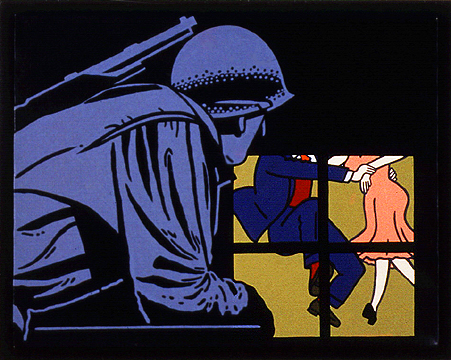
Thursday, March 18 at 7pm
Wing Luke Asian Museum
719 South King Street
An American Diary, A Lecture by Roger Shimomura
Roger Shimomura will present An American Diary, a 60-minute lecture on his work spanning over 40 years. Shimomura's paintings, prints and theatre pieces address sociopolitical issues of Asian America. Learn how his work has been propelled by various historical and political events, as well as his own physical environment which has been constantly filled with his collections ranging from Walt Disney memorabilia to World War II stereotypes of Asian people.
Shimomura website
Regina Hackett review of the current exhibit showcasing Shimomura--Yellow Terror--on view through April 18th.
Jen Graves's review
Monday, March 1, 2010


Subscribe to:
Posts (Atom)